Follow

Showing posts with label Vladimir Rybaltchenko. Show all posts

Thursday, December 10, 2020

Hermès Scarf - Springs

 The Hermès scarf, Springs, was designed by Philippe Ledoux in 1974.  


The inspiration for the center carriage is a child's carriage commissioned for Napoleon's son.  

The carriage can be seen at the World of Habsburgs webpage.


Each corner has a different carriage.
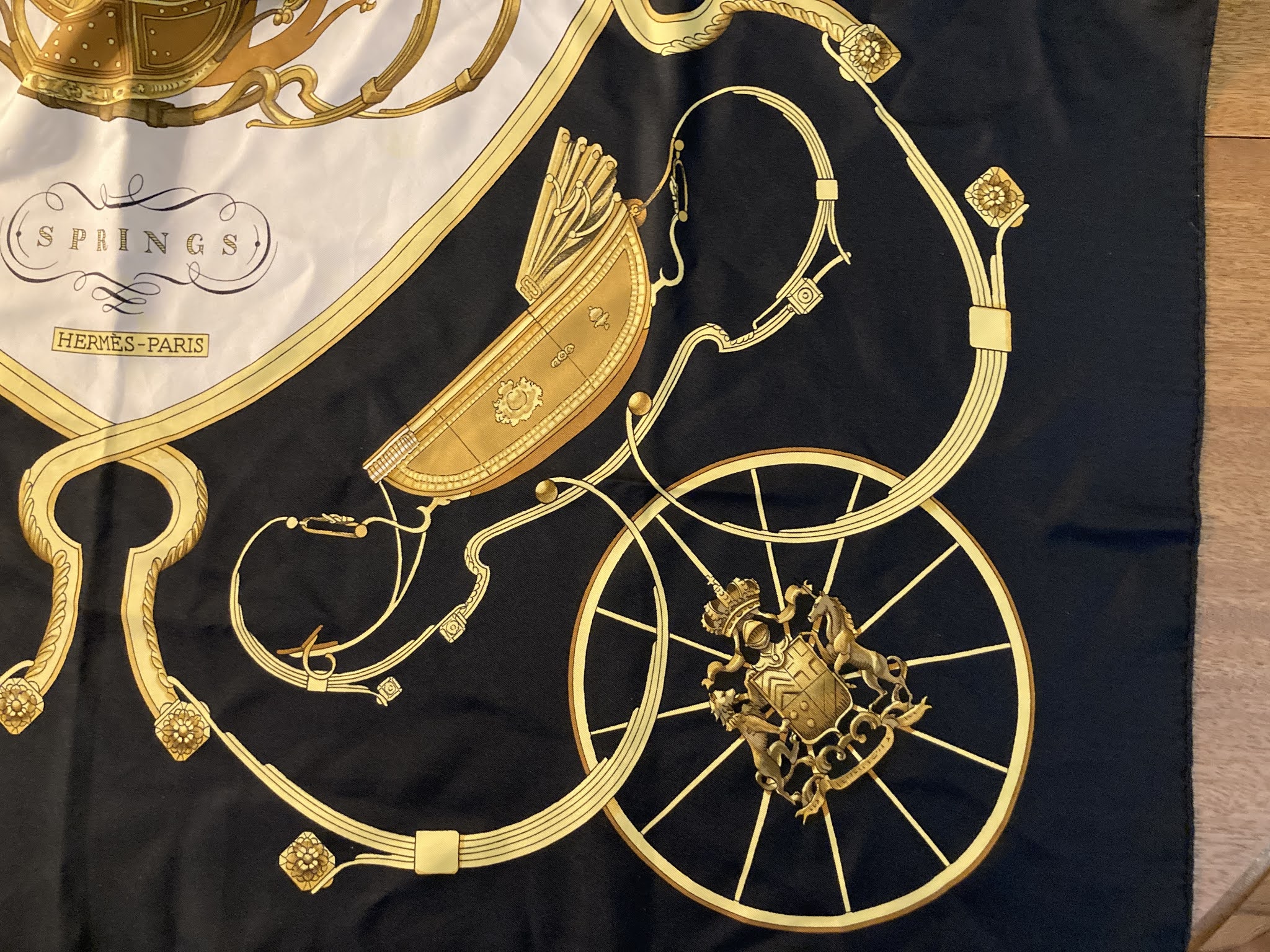


Like all the Hermès scarves, this drapes well.  It's fun to wear, and since it has a pulled thread and the last cleaner messed up by ironing the hems flat, I will feel free to enjoy wearing it.


I have not been able to find a copyright, so if it's "hidden", it's hidden well!  With no copyright, I would assume this was made before 1972.  I was also unable to find the artist's signature.  If it were signed, it should say LEDOUX, probably to the left of the carriage wheel on the bottom right corner.  It may be there as black on black?

Philippe Ledoux, the artist on this Springs scarf,  began working for Hermès in 1947, and he continued until his death in 1975.  He designed 90 carres, including two that were completed after his death by his nephew, Vladimir Rybaltchenko.  Two other scarves by LeDoux that I have are Napoleon  and the Promenade de Longchamps. (I have two different colors of "Les Cavaliers d'Or" by Rybaltchenko.)

To see the other Hermès scarves I have blogged, click here.

Sunday, May 10, 2020

Hermès Scarf - Les Cavaliers d'Or


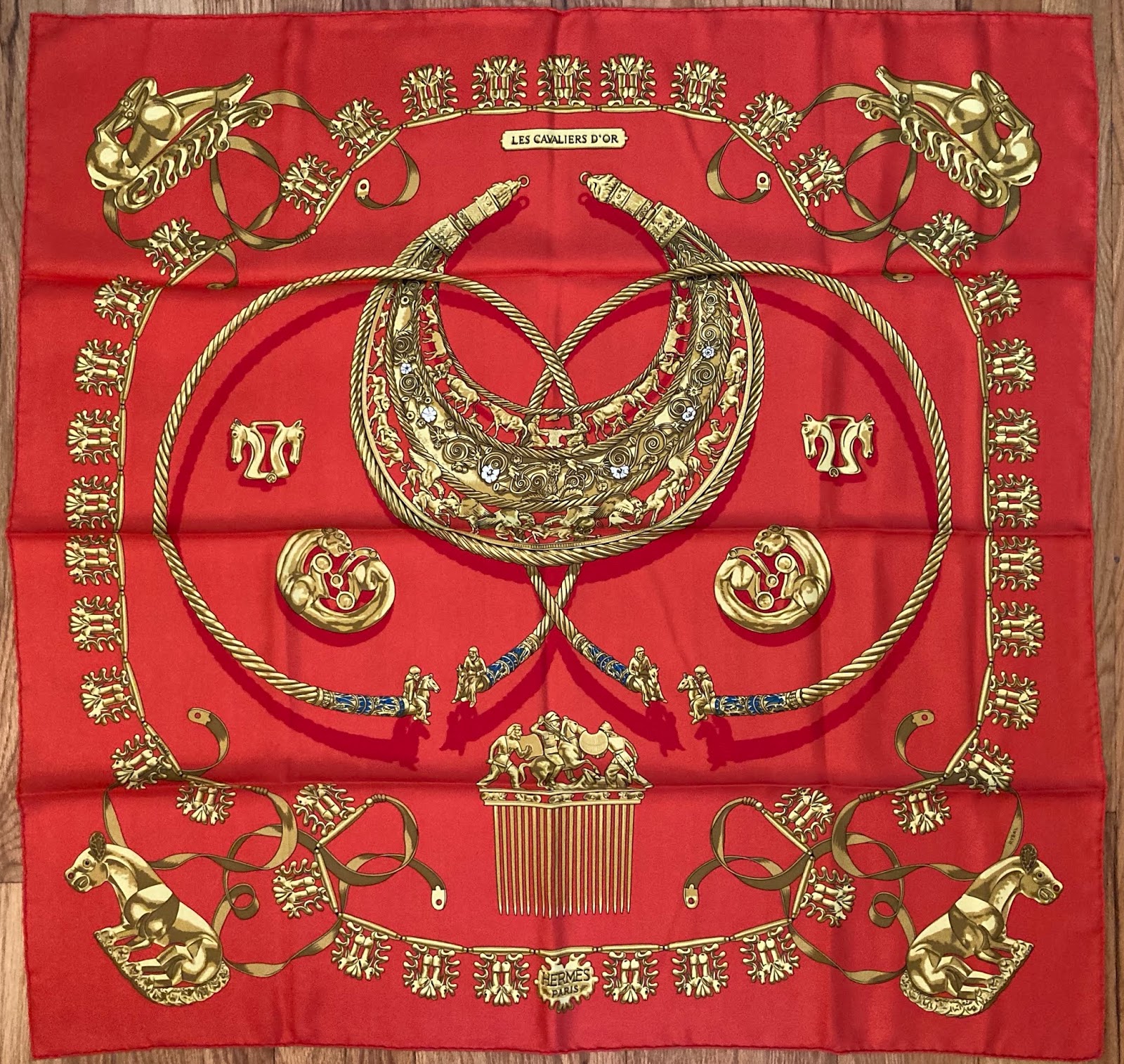
This lovely scarf, Les Cavaliers d'Or, was designed for Hermès by Vladimir Rybaltchenko in 1975.

This scarf, designed in 1975, is the only Hermès scarf designed by Rybaltchenko in the Metropolitan Museum of Art design collection.


The title, "Les Cavaliers d'Or", could translate as "The Golden Horsemen".  It shows pieces of Scythian Gold, mostly now in the Hermitage Museum.  The Scythians were nomads in the 7th to the 4th Century BC.

Vladimir Rybaltchenko signed his Cavaliers d’Or as “Rybal”.  (I guess I would consider abbreviating a long name. . . )
The 1975 issue is signed under a horse.  This one is signed on a ribbon.


In two of the corners there are cougar type animals.

This one has the © HÈRMES on the bar above the animal's head.


In the two other corners are reindeer type animals.  The gold reindeer date from about 600BC.


Scythian Gold is found in the Hermitage Museum.
The pieces date from the 4th to the 7th Century BCE.
Hard to believe these stunning works were made during the Iron Age.

The central pectoral is described in Wikipedia:  
"Gold pectoral, or neckpiece, . . . dated to the second half of the 4th century BC, of Greek workmanship. The central lower tier shows three horses, each being torn apart by two griffins. Scythian art was especially focused on animal figures."
 Those curved plaques may be panthers chasing their tail.
There are loops on the back of the original gold to be able to fasten them to clothes.
The torques with horsemen on the ends date from the 4th Century BC.
For a fascinating analysis of the pectoral, from a jeweler's point of view:  https://www.ganoksin.com/article/great-pectoral-tolstaya-mogila/

 The Hermès logo is on the medallion beneath the hair comb.  The comb with battle scene dates from the 5th-4th century BC.


Like all the Hermès silk scarves, this drapes well.


(FWIW, Vladimir Rybaltchenko 1939 - 2002 was the great-nephew of Philippe Ledoux and father of Dimitri Rybaltchenko, all outstanding Hermès artists.)

These scarves are endlessly fascinating.  I love the attention to detail - in the scarf above, notice the shadows cast by the torque.

Oh, ho!  I had the opportunity to get the same scarf in green.  Also lovely.


To see the other Hermès scarves I have blogged, click here.