Follow

Showing posts with label King Arthur flour. Show all posts

Saturday, April 17, 2021

Making Rye Bread

For a first attempt at rye bread making, we chose the recipe from King Arthur Flour for "Classic Rye Sandwich Bread".

It calls for:

Ingredients

  • 1 1/2 cups (159g) medium rye flour
  • 1 3/4 cups (210g) King Arthur Unbleached Bread Flour
  • 1 teaspoon (6g) salt
  • 2 teaspoons caraway seeds - optional
  • 1 tablespoon minced dried onions - optional
  • 2 teaspoons instant yeast
  • 1 cup (227g) water, lukewarm (105°F to 115°F)
  • 1 tablespoon (22g) molasses or honey
  • 1 1/2 tablespoons (22g) unsalted butter, melted

We are not fond of the crunch of seeds in our bread, so I omitted that, and since we had no dried onions, we omitted that, too.  I used dark molasses for the sweetener.


It appears that this should have proofed longer.  It is heavy and dense.
Notice there was no "oven spring".
It reminds us of those little square rye breads that were so popular in the 50s and 60s for hors d'œuvres.

If that's what you're thinking of, it was very good.
However it had no rye flavor.
I think it was definitely missing the caraway seeds.
~

Second Attempt

Using the same recipe, I made some changes.

I made a preferment the night before with 50 grams water and 50 grams rye and a bit of yeast.
A while ago, we got a new coffee grinder, so the old one became a spice grinder.  I ground up some caraway seeds and added two teaspoons of caraway seeds which I had ground up, giving it the flavor but less of the crunch of seeds.

That was left, covered, to rest overnight.  

What is a preferment, you might ask?  
Here's what Bon Appetit says:

What is a preferment?

Unlike a “straight dough,” in which all of the ingredients for the final dough are combined at once, bread made with a preferment is mixed in two stages: A small portion of the dough is prepared in advance—usually 6–16 hours—and allowed to ferment; then, once it’s bubbly and full of yeast, acid, and bacteria, it’s incorporated with the remaining ingredients—flour, water, salt, and, sometimes, more yeast. The dough then has its bulk rise, where it grows in a bowl or container, before it’s shaped (into buns, breadsticks, loaves, what have you) and left to proof once more.

I had to laugh.  In looking this up, 
I realized that it is not a very French "pray-fair-mahnt".  
It's a pre-ferment.   Funny!

When the preferment was combined with the rest of the ingredients, it made a very sticky dough.

I knead using the stand mixer, and this got a 10 minute rest, 10 minute kneading, 10 minute rest, and again a 10 minute kneading.  (The Cuisinart stand mixer has been a workhorse. I bought the first one in 2009, at a time when Kitchen Aid had changed to plastic gears and was getting poor reviews.  I bought another one in 2017 when we were living in two houses, and I needed one in each.  So now I have the one in the kitchen and a back-up for just in case.  Makes me feel very secure!)

I also added a tablespoon of cider vinegar to the dough, since the first recipe wasn't as tangy as expected.

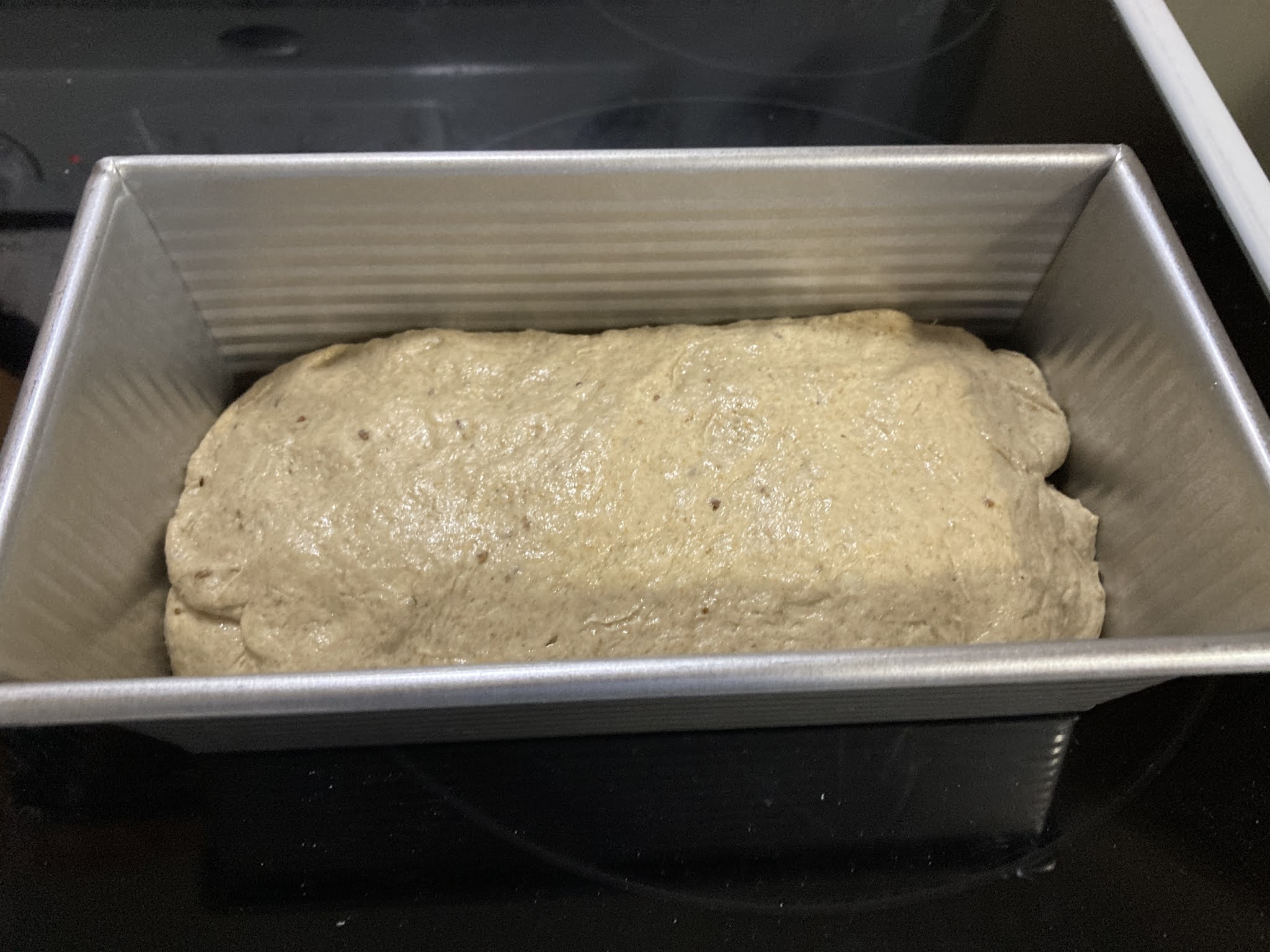
After the first rise, it was shaped and put into the pan:

Looks like this may have been over-proofed.  We'll see.

"


It did collapse a bit in the oven.


It is really delicious.  Light, tangy, full of caraway flavor without the crunch.
It is more the texture of a sandwich bread.
It also has a tender crust.
It does not have the rubbery texture of deli bread though.
But since it was really delicious, we may just buy deli bread if we want rubbery.

R suggested using Nina-in-the-Kitchen recipe.  I did a quick spreadsheet, and they are virtually identical.  Check out Nina if you prefer to see a video.

The addition of caraway seeds to rye bread is to counter the bloating that can be caused by the high fiber content of rye. Caraway has well-known anti-flatulence properties; however, the association is so long-standing that the flavor combination is now almost inseparable.

Hmmmmm


Wednesday, August 5, 2020

King Arthur Blueberry Muffins - copy of Jordan Marsh muffins


Karen gave me a pint of blueberries.  She had picked them on her property.  They are delicious, small, and with concentrated sweetness.  I came across this recipe from King Arthur that sounded like a great use of the berries.  https://www.kingarthurbaking.com/recipes/famous-department-store-blueberry-muffins-recipe

These muffins copy the recipe of the treat sold in the tearoom of Jordan Marsh Department Store in Boston, Massachusetts in mid-20th Century.  It has a crunchy sugar top.  If it helps you to see the video, you can see it on the King Arthur page, but, fair warning, these two are experts at making a long story longer.  


1/2 cup (8 tablespoons) butter

1 cup sugar, plus 1/4 cup for topping  Will probably use 3/4 cup granulated sugar in the next attempt

2 large eggs

2 teaspoons baking powder

1/2 teaspoon salt

1 teaspoon vanilla extract  I used my own home-made bourbon vanilla

2 cups King Arthur Unbleached All-Purpose Flour  I used Aldi's all-purpose

1/2 cup milk

2 1/2 cups blueberries   I used two cups, because that's what I had.


375°

25-30 minutes  


I had just two cups of berries, but that was plenty.


I love the USA Pan.  It's silicone coated, and I do not have to use  paper cupcake liners.

And I don't have to grease the tin.

And the muffins do not stick, even with the sugar baking on the tin.

And cleanup is a breeze.

And there is no waste like when the cake sticks to the paper. . . 


With this pan, the edges brown nicely.

The pan is not cheap.  But with the money saved on cupcake liners, and the aggravation saved by not greasing, and the time and energy saved by easy cleanup, it may be worth it!  

It is to me.


The recipe called for one teaspoon of granulated sugar added to each cupcake.
I did half with Demerara Sugar, a crystalline, slightly brown sugar.


The other half got regular granulated sugar.


I much preferred the Demerara.  D much preferred the granulated.  So it goes.


Saturday, August 1, 2020

Pane Bianco - a recipe from King Arthur Flour

What a stunning loaf of bread:
This is a picture on the KAF website:  https://www.kingarthurbaking.com/recipes/pane-bianco-recipe

We  have plenty of basil and tomatoes. .  . The next few days are predicted to be super-hot and super-humid, so if I want bread, I'd better do it today!  

Dough
  • 3 cups (361g) King Arthur Unbleached Bread Flour*
  • 2 teaspoons instant yeast
  • 1 1/4 teaspoons salt
  • 1 large egg
  • 1/2 cup (113g) lukewarm milk
  • 1/3 cup (74g) lukewarm water
  • 3 tablespoons (35g) olive oil
I measured wrong, and used 74g milk and 113g water. . .  I did put in the salt - that was probably a mistake. . . 

Filling
  • 3/4 cup (85g) shredded Italian-blend cheese or the cheese, of your choice
  • 1/2 cup (113g) oil-packed sun-dried tomatoes or your own oven-roasted tomatoes                              I                                      I used 2 fresh san marzano tomatoes
  • 3 to 6 cloves garlic, peeled and minced. I used 4
  • 1/3 cup (14g) chopped fresh basil, green or purple I used 1/2 cup chopped parsley and basil
  •                                    I also added 1/3 cup chopped Kalamata olives Better leave out the salt if using olives!
  • And because I was using fresh tomatoes, I added a splash of olive oil.

The dough came together beautifully in the Cuisinart stand mixer.  

I picked and chopped the parsley and basil, and sliced and chopped two San Marzano tomatoes (They are plum tomatoes and not very juicy.).  

I got to test out the garlic trick shown on the Netflix series with Nadiya.  Drop the cloves of raw garlic into a bowl of boiling water for one minute - the garlic won't be in long enough to cook, but the skin will slip off.  Sweet!  
Alas, it didn't work. . . 

Had to do the finicky hand peeling - I could have smashed them to make it easier, but. . .  I guess the easiest way to peel garlic is the same as always - smash them flat with the side of a knife, then peel and chop - That's fine if you are planning to chop or grate the cloves.  Won't work if you were hoping for whole cloves.

After the first rise, it was stretched out on a cookie sheet.  And the filling was spread on top.

Then it was rolled.


When rolling was complete, there are directions for cutting and shaping.

I did try to understand the directions, but they made no sense to me.
I'll need to find a video.

Here are the directions:
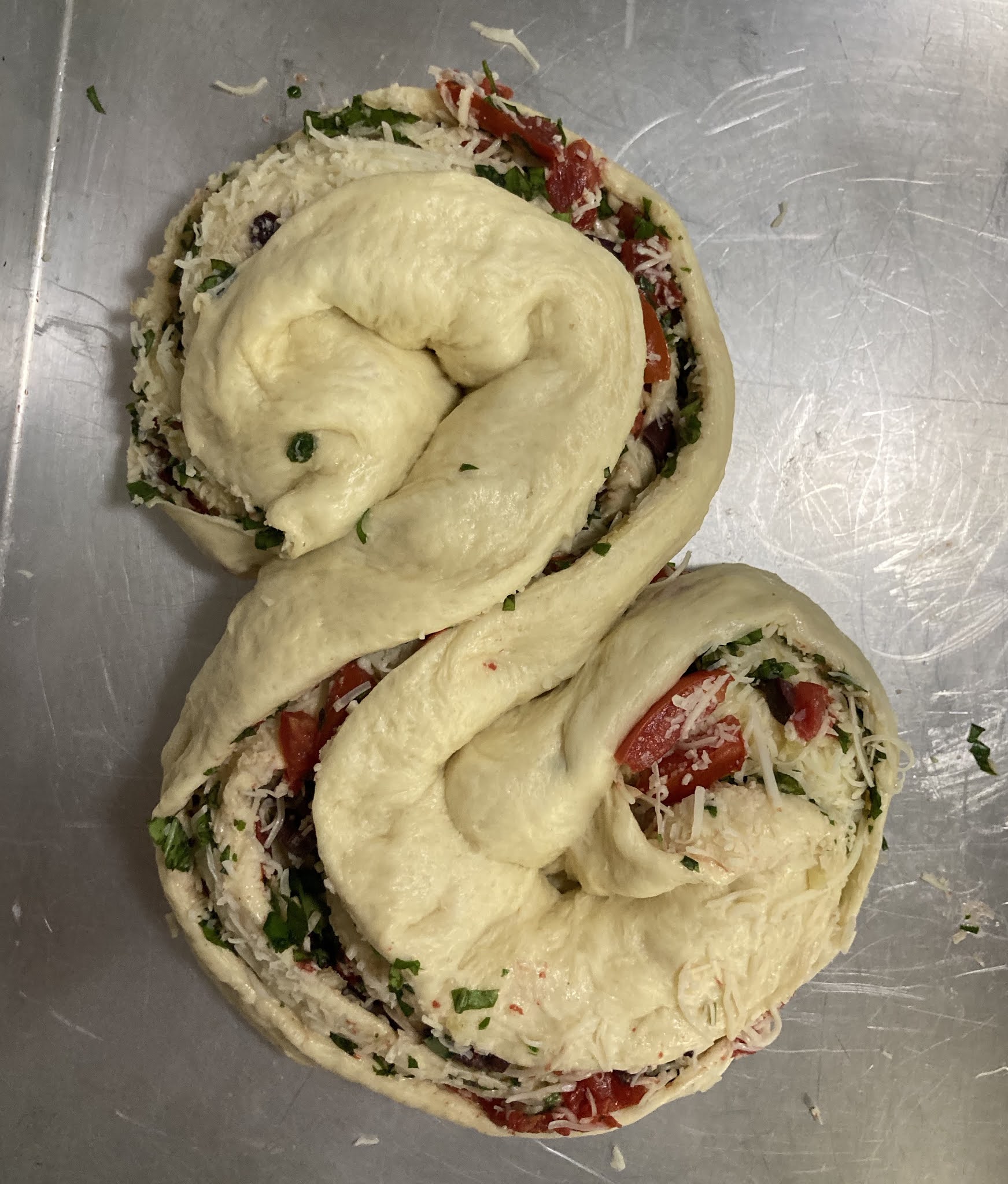
Using kitchen shears, start 1/2" from one end and cut the log lengthwise down the center about 1" deep, to within 1/2" of the other end.

Keeping the cut side up, form an "S" shape. Tuck both ends under the center of the "S" to form a "figure 8;" pinch the ends together to seal.


I could not make sense of that, so I just did what I could.
Alas, it bears no resemblance to the plan.


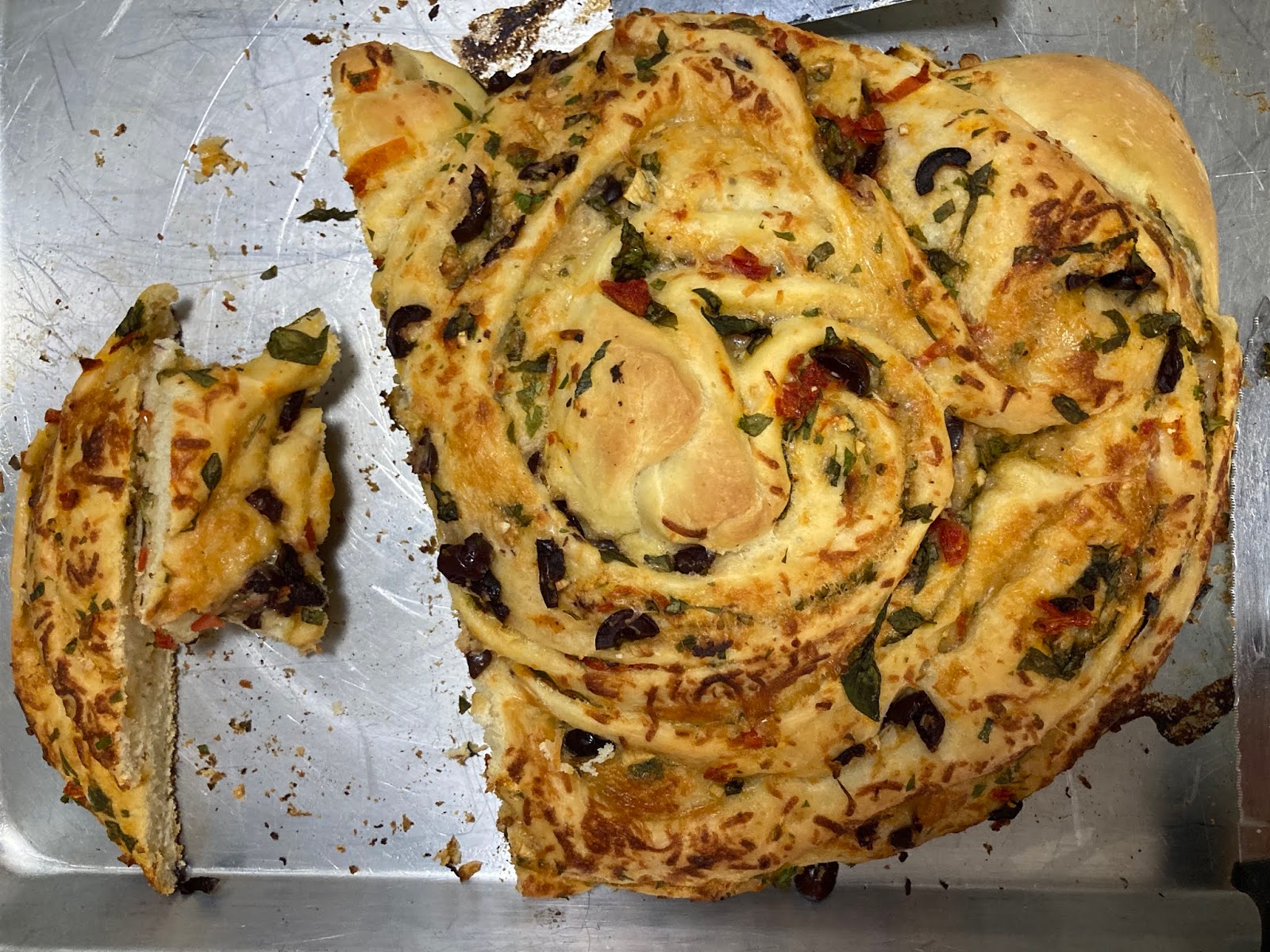
Here's the final result. 

It is delicious - a bit salty - so next time, if I add olives, I'll omit or reduce the salt in the dough.
We really liked it.  Very tender but very flavorful.  It's a keeper!

August 6, 2020

I contacted King Arthur by using the Ask a Question link on the recipe page, because I could not, for the life of me, figure out what they were telling me to do about the shaping.  They gave me a link to more pictures and it made more sense.  I tried again:
This is more like it!  It's still delicious.  
And it looks better, too!

I did omit the salt in the dough.  Next time, I'll use 1/2 teaspoon of salt rather than none.

Monday, April 13, 2020

Naan 2020


Tired of the same old, same old.  Something different is needed.  That will be naan.  Haven't made it in a while.  Looking at recipes on the web and ones I've used in the past, I decided to experiment.  Here are the results:

Ingredients:
1/2 c water
yeast
1 t sugar
5.3 oz yogurt
salt
2 cups flour

I always use the stand mixer, and today was no different.
I combined the ingredients, except for the salt.  

I have liked using a technique called "autolyse", which basically means combine the ingredients except for salt, and let it rest for 30+ minutes.  (Some recipes hold out the yeast, too).  
King Arthur Flour has an interesting, fairly technical article on autolyse:  https://www.kingarthurflour.com/blog/2017/09/29/using-the-autolyse-method

After a rest, add the salt (and yeast) then knead for 10 minutes or so.

After the first rise (90 minutes or so) the dough was divided into 8 pieces and the pieces were shaped into balls.  After a rest of 20 min, the dough was flattened into shape for naan.


The frypan was heated and the breads were cooked one-at-a-time.  As they were cooking, they were brushed with melted butter.

When one side had nice leopardy brown spots, the bread was flipped to the other side to finish cooking.


As each got done, it was put into a 200Âş oven to keep warm.


They were delicious.  A bit chewy, which I like!

The naan should hold up well with curry!
This recipe is a good one!


Monday, September 1, 2014

No Knead Bread from King Arthur Flour


We went to the Oxford Farmers' Market on Saturday.  Now that we have our first Cherokee Purple tomatoes, it was time for Tomato, Cheddar, and Mayo sandwiches on good bread.  There was an artisan bread baker who had lovely ciabatta bread for sale at $5/loaf.  It was nice to learn that my bread is better!!!  So it was time to get baking.  This time I used the recipe from King Arthur Flour.

After a two-hour initial rise, I left the dough in the refrigerator in a covered plastic tub overnight.

The next morning I shaped half of the dough.


Baked in a 550 oven, turned down to 425 half-way.
The internal temperature was 200, so it was done, but I think it could have stayed a bit longer or at a bit higher temperature.

The crumb was not the big holey type I was expecting.
 Perhaps it needed less or more rising time???
It was delicious, and there is still dough in the refrigerator to make more!

Friday, November 15, 2013

Spent Wheat Bread

A friend is a beer maker, so when I found a recipe that uses the grain leftover from making beer, I sent the idea along - lo, and behold, I received the offer of wheat that they had just finished using in making beer.  I expected a cup or two - but a gallon arrived!!!!

This recipe rambles, because I was making it up as a went along, but it made a lovely loaf.

I mixed one cup of water, one cup of AP flour, and 1/4 teaspoon of yeast, covered it, and let it sit overnight.

The next day, I mixed 1 cup of hard cider, 1/4 cup honey, 1/3 cup spent wheat, 1 teaspoon salt, and 280 grams (that was what was left in the bag. . . ) of whole wheat flour.  (That's probably about two cups.)  And I added the flour mixture from the day before.  After mixing well, it was obvious that more flour was needed.  I added 1 cup bread flour, and because that still was not enough, I added 1/3 cup AP flour.

You may notice I'm getting rid of the odds and ends of flour in the house!

After beating with the Cuisinart mixer until it pulled from the sides of the bowl (about 10 minutes), I set it aside to rise.

After it had doubled in size, I folded it a few times and shaped it.

 I slashed the top, as is recommended for French bread or country boules.

I intended to bake in a preheated lidded pot - but when I put it in, it was too big to put the lid on, so I just baked it at 425 for 30-40 minutes.
 It has a nice texture, with the wheat chunks.  The wheat I received was quite dark, and the bread flavor approaches pumpernickel.  It will make great grilled cheese if I use a strongish cheese like gouda or muenster.


We'll have to try that tomorrow.  Today D had it with soup, and I had it plain.

Excellent!

INGREDIENTS:
1 cup water
1 cup hard cider
1 1/3 cup All Purpose flour
2 1/4 cup whole wheat pie and pastry flour (King Arthur)
1 cup bread flour (Sir Lancelot)
1/3 cup spent wheat left over from beer making (double it in the future)
2 1/4 teaspoon yeast (Red Star)
1/4 cup honey
1 teaspoon salt